Archive for February, 2012

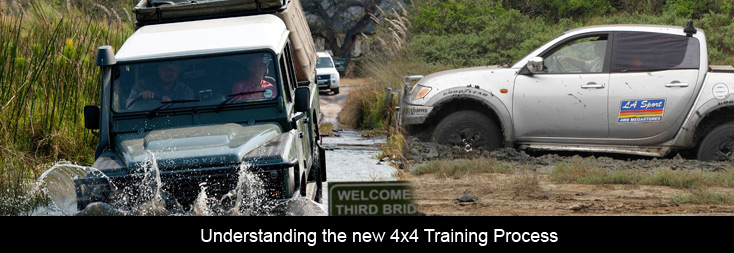
Understanding the new 4×4 Training Process

As you are aware, the face, methods and quality of 4x4 driver training has changed significantly since the beginning of 2010. To be able to conduct and present 4x4 driver training against unit standards  254135 and 254154, the training institution must be a registered training provider with TETA  and the facilitators and assessors must be qualified to facilitate and assess against the relevant unit standards.

After moderation of the training process and assessments, students who are found to be  competent, against the relevant registered unit standards, will be issued with a certificate of competence by the accredited Training Provider and a statement of result by the SETA (named TETA)

As you might have read in the media and in the correspondence of organisations as “NOW” (National Offroad Work Group) and “AAWDC” (Association of All Wheel Drive Cubs”, the target date for government to identify and publish the so-called “sensitive” areas initiative, where you will need this “DCC” (Driver Competency Certificate) is 2014. Now this may seem far in the future, but most people are going to wait to the last minute to get their “DCC’s). As you know yourselves, 99% of 4x4 trails in South Africa and our neighbouring countries are in so-called sensitive areas. The reason being that the routes are either in National or Private Game Reserves, in Mountains areas where erosion is a factor, in Desert areas, along Coastlines or in World Heritage declared areas.

This process has been implemented and are in the process of finalization towards 2014. There’s not going to be more discussions on it, the process and results has been decided on already and all new prospect 4x4 drivers should be trained according to the new process.

As you should be aware there is no need for drivers/people who has done a proper 4x4 course or has gained relevant experience by driving 4x4 trails and do 4x4 overland trips, to do the complete new course, according to the registered unit standards. If you can submit evidence (certificates) and information on trips that you have done (photo’s or video’s), you can apply to be assessed under the “RPL” (Recognition of Prior Learning) process.

We acknowledge and appreciate the fact that you spent time, money and effort on 4x4 & off-road training. This proves a positive attitude towards training and self-development. We will evaluate your prior learning and experience and take it into consideration when calculating your notional hours of learning. It might for example mean that you only have to do the practical tests, to determine whether you are able to apply the correct driving techniques.

This is not a new system invented by someone who want to make a quick buck, but a system lobbied for  by all the 4x4 drivers and enthusiasts, who has contributed via , clubs, forums and organizations such as “NOW” and “AAWDC” to get a proper, quality and standardised controlled training process in place. Furthermore this process must convince government and environmentalists, that we can regulate ourselves and drive and behave properly and civilized, to ensure that we can drive and enjoy our treasured 4x4 destinations in and around our beautiful country. However the trainers are going to make a quick buck, once you realized that you’ve waited to long and you are not allowed into a destination, because you don’t have the new “DCC” card. You might then end up paying a lot more to get your “DCC” on very short notice, together with thousands of other 4x4 drivers in the same situation.

Photo by Gerhard Steenkamp/ Superimage/ Phototalk

To familiarized yourself of who African Offroad Academy is and why they are being considered the only competent, accredited  and qualified training provider at present in South Africa, go and visit their website at: www.africanoffroad.co.za

As a member of African Offroad Academy, Just 4x4 Adventures in Bloemfontein are a 24/7 training institution, meaning that we do training every day, except Sundays. Full training is now a multiple day process, meaning that typically you will receive the theoretical training on a Friday night. (18:00 to 22:00) Then you will do practical training for a full day (Saturday). You will receive a task where you will have to go and do some research on your specific 4x4 vehicle as well as 4x4 related subjects and then complete this task. You will then make an appointment with the 4x4 Assessor where you will hand in your written task and do your practical driving tests.

If the Assessor finds the candidate to be competent, he will submit the results to an African Offroad Academy Moderator who will moderate the process and give the results to TETA, who will issue your “DCC” certificate. So unfortunately your friend,  who are a 4x4 instructor, can’t help you to get the “DCC” without going through the process. African Offroad Academy also have the internal policy that the instructor and assessor can’t be the same person and instruction and assessment can’t take place on the same day.

Cost of training for the formal 4x4 Driver Competency Certificate is R1350-00. Costs however may vary depending on whether training is done for individuals or clubs. Club discounts do exist. “RPL” students costs depends on the level of experience and notional hours of learning they have clocked. It will however be less than formal training.

For more information or bookings, contact:

Andre Botha (4x4 Overland Tour Guide GP3431 & 4x4 Assessor)
Just 4x4 Adventures
Bloemfontein
South Africa
Approved Member of African Off-Road Academy
AFRICAN OFF-ROAD ACADEMY is an accredited training provider under TETA (TETA09-201)
to train, assess and issue an official Off-Road Driver Certificate
in relation to the unit standards US254135/254154 for 4x4 & off-road driving}
Tel: 0825766058
Fax: 0866121810
www.just4x4adventures.co.za
andre@just4x4adventures.co.za

For 4x4 Vehicles and Car Insurance also view:

Protect yourself when on driving on safari Out-In Africa

“Guide to safety and driving on safari / driving in the nature reserve”

Road Safety for foreigners travelling in South Africa

4x4 Vehicle Safety and Driving off-road

High performance shock absorber could reduce accident risk for 4×4 vehicles


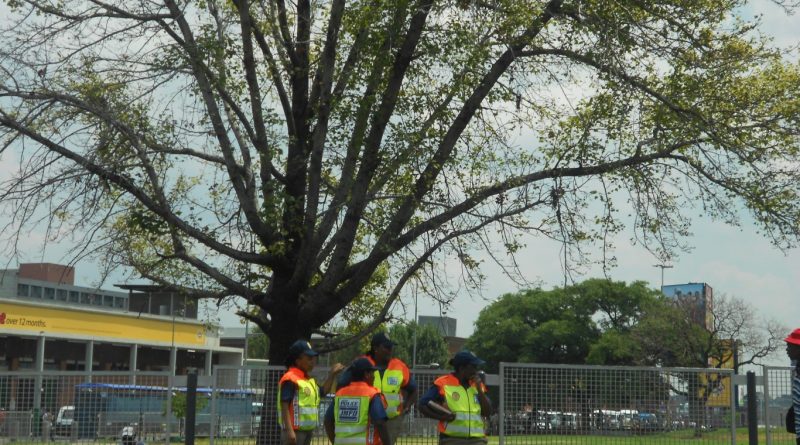
A new approach to the training of Traffic Officers

In 2011 the first 244 Traffic Officers were trained in a one year full qualification which is registered with the South African Qualifications Authority (SAQA). The qualification, Further Education and Training Certificate (FETC): Road Traffic Law Enforcement ID 62289 was registered on the National Qualifications Framework - Level 4 with 142 credits and is now the minimum standard for the training of Traffic Officers.  This qualification lies within the primary focus area of the Safety and Security Sector Education and Training Authority (SASSETA).

Currently there are thirteen Traffic Training Colleges that have been approved by the Minister of Transport in terms of the National Road Traffic Act (NRTA). These thirteen Colleges are the only Colleges that can train a person to qualify, be registered and be employable as a Traffic Officer in South Africa. It must be emphasized that any person who wishes to be employed as a Traffic Officer must be trained for one year at an approved Traffic Training College as from January 2011. The training will include both theoretical and practical training. The approved Traffic Training Colleges are listed below:

NAME CITY/ PROVINCE CONTACT NR.

1.   Limpopo Traffic Training College Polokwane - Limpopo (015) 967 0467
2.  Boekenhoutkloof Traffic Training              College Pretoria - Gauteng (012) 372 8000
3.   KZN Traffic Training College Pietermaritzburg – KZN (033) 394 0202
4.   Lengau Traffic Training College Bloemfontein - Free State (051) 409 0444
5.   Mangaung Traffic Training College Bloemfontein – Free State (051) 412 8100
6.   Gene Louw Traffic Training College Cape Town  – Western Cape (021) 983 1501
7.   Durban Metro Police Department Academy Durban – KZN (031) 701 0462
8.   Johannesburg Metro Police Department Academy Johannesburg - Gauteng (011) 429 5010
9.   Tshwane Metro Police Department Academy Pretoria – Gauteng (012) 358 0005
10.  Ekurhuleni Metro Police Department Academy Springs – Gauteng (011) 812 8700
11.  Port Elizabeth Traffic Training College Port Elizabeth – Eastern Cape (041) 390 4501
12.  Matjhabeng Traffic Training College Welkom – Free State (051) 876 2224
13. Cape Town Metro Police Deapartment Academy Cape Town  – Western Cape (021) 447 2366

The public should note that there are numerous training providers who claim that they can train Traffic Officers and issue certificates with which a person can be registered and be employed as Traffic Officers. Only the relevant certificates obtained from the above mentioned 13 Colleges can currently be used to register a Traffic Officer in terms of the National Road Traffic Act (NRTA). Prospective learners at these 13 Colleges must also be aware that the Local or Provincial Authorities normally pay the training fees directly to the College electronically. Learners must take caution and not pay any individual to secure “a space” at a Traffic Training College. Applicants are advised to ensure that the Colleges that they use for the Basic Traffic Officer’s Course are fully registered, accredited and approved in terms of the NRTA.

For further Information: Ashref Ismail – 071 680 3448

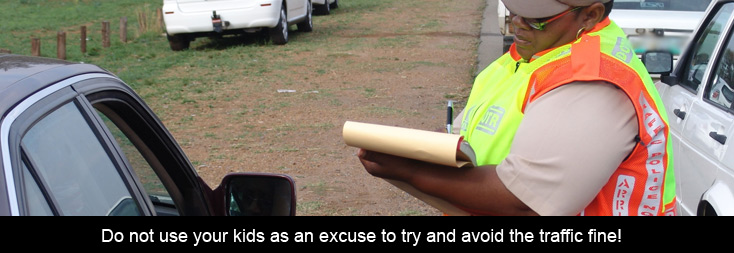
Do not use your kids as an excuse to try and avoid the traffic fine!

Not only are many motorists neglecting to secure their children with seatbelts or child restraints, they are even using them as an excuse when stopped by traffic officers!

The Arrive Alive website received an email with a link to some of the most used excuses:

  1. He’s Sick – Even the most hardened law enforcement officer is likely to be softened by the tale of a child that doesn’t feel well. Claiming that your child has a high fever or is feeling nauseous can be effective, but only if he actually appears to be ill.
  2. She Has to Use the Restroom – Especially useful if your child is at a potty-training age, using your child’s need to visit the restroom can appeal to the officer’s sensitivity as well. If they’re a parent themselves, you’re even more likely to get by with a warning.
  3. You Forgot to Pick Them Up – Getting the dreaded phone call from a teacher or coach reminding you to pick up your child can make you feel like a horrible parent. However, if you’re breaking the speed limit to get to them, a police officer might be sympathetic.
  4. They’re Late for School – Trying to get your brood to school on time can be a challenge, so if you’re driving a bit too fast in order to beat the last bell, you might find yourself in an officer’s sights. Explaining that you’re trying to get your children to class might keep you from a fine.
  5. You’re in Labor – Women in the later stages of pregnancy can use it to cover all manner of sins. Claiming you’re in labor might get you out of a ticket, but it might also get you a police escort to the hospital.
  6. They’re in Trouble – Telling the police that you’re rushing to get to your child because they’re in some sort of mild trouble can be useful, as long as you’re careful not to over-embellish your story.
  7. You Left a Comfort Object Behind – Kids that have an attachment to a comfort object like a blanket or stuffed animal can have a terrifying meltdown when that object is left somewhere. If your toddler is howling when the officer approaches the window, this excuse might be useful.
  8. They Need Medication – Telling a police officer that your child takes daily medication on a time-sensitive schedule can potentially help you avoid a ticket.
  9. Trying to Buy Diapers Before the Store Closes – Parents in rural areas without 24 hour convenience stores can employ this excuse with ease; explaining that your child needs diapers or some other essential item before a store closes might keep you from a fine.
  10. You Were Distracted By Their Behavior – Telling the police officer that you were unaware of how fast you were driving because you were distracted by the behavior of your children might get you out of a ticket, but it might also backfire. Admitting that your attention was focused on something other than driving safely should be done carefully.

Rather than focus on these excuses consider the safety of children when climbing behind the steering wheel! Ensure that they are all buckled-in and are taught from an early age not to distract the driver!

[Info from Live-in-nanny]

Also view:

You can make a difference by Reporting bad drivers!

We would like to share a report on bad driving sent to the Arrive Alive Website:

Report:

To whom it may concern,

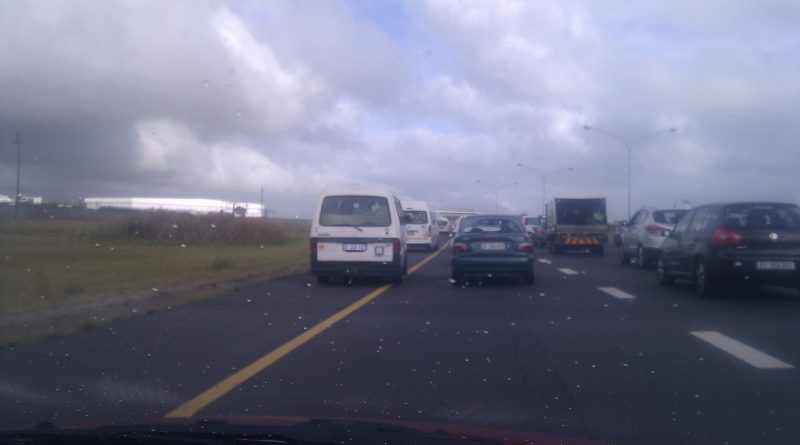
I travel on the N2 from Somerset West to Observatory and back every weekday and observe many instances of dangerous driving, undisciplined driving and especially anarchy by the taxi brigade.  I would like to discuss two instances, specifically:

  1. On 22 February, my colleague and I travelled home from work and at the usual bottleneck at Borchard’s Quarry road near the airport, when traffic came to a standstill, we again experienced many taxis passing on the yellow line on the left side of the road (on the bridge), then move across onto the slipway that feeds traffic from the airport onto the N2 and further continue to pass vehicles while driving to the left of the yellow line.  I was in the left lane of the N2 and already past the entrance of the slipway, when the taxi in the photo (CF 108 187) followed his mates in this manner.  I was driving on the left of the left lane,  but not in the yellow lane, when this taxi found he had to put two wheels on the gravel to pass me and when I did not make way for him, he drove past and I heard a loud bang as the driver hit my left passenger window with his fist.  He continued to signal bad gestures at me while hanging his head outside the driver-side window.  The taxi was full of passengers.  I then took the picture labelled “CF 108 187.jpg”.

My   question is – when is our traffic department going to stop this kind of undisciplined, aggressive driving by taxis.  We just hear the WC minister of transport making statements on TV when accidents happen (or during Christmas holidays), but we still do not see a plan to get discipline and safety back on our roads.  Why do we have to wait for more accidents to happen?  It seems that it is just easier to photograph and fine motorists who travel slightly over speed in locations where the speed restriction is completely unfair – e.g. 70km/h on N2 opposite the Somerset Mall, where there are no pedestrians and not supposed to be pedestrians.  I have never seen a speed trap in the taxi lane where more often than not, while driving at 120km/h in the middle lane (before 09:00 when the right lane is a bus and taxi lane), fully laden taxis come screaming past me in the taxi lane, while they are supposed to drive at 100 only.

  1. I have had an issue with the double-decker Golden Arrow buses for many years now.  These buses tend to lean over to the left and watching them over time, the condition get worse.  I have reported this at times to the N2 emergency number and the staff at the satellite station near the airport and found that they then acted and pulled over the bus driver.  But on their own, traffic officers do not seem to notice that these buses are becoming dangerous - especially to the passengers – and one day, one of these buses will overturn and people will get hurt.  It is much easier to catch motorists for speeding, of course.  I have had a photo like the one attached, published in the Cape Argus, but Golden Arrow does not seem to show any concern for the safety of its passengers.  This one was taken quite recently (17 February 2012).

I have 42 years of driving experience and grew up in a home where my father was always concerned about road safety, and was a member of the Road Safety Association.  I have many more concerns about how the lack of discipline and excess of poor and aggressive driving is causing accidents and deaths on our roads.  It seems that our provincial and metro transport and traffic departments are quite ignorant of the real causes of accidents on our roads.  They may quote some statistics to show that it has improved somewhat, but there are still crucial things that they do not do – especially getting taxi and bus drivers tested psychologically before issuing a PDP.  This could have prevented the death of 10 school children in train crossing accident some time ago.  But we must get basic discipline back on the road – I can send you a long list of driving offences observed on a daily basis – quite often in front of passing traffic officers – while no action is taken.

Something that really shocks me every day is to see taxi after taxi driving with NOBODY on the front seats ever wearing safety belts. And even police officers that never wear safety belts.  WHY IS IT ALLOWED?

I worked in the USA (California, Illinois and Georgia) for a number of years and observed how discipline can be enforced on the road – maybe we should get a few of those police officers here to teach our traffic departments how to do it.
Regards,

Concerned Citizen

We shared this with the National Traffic Call Centre and the Safely Home Campaign in the Western Cape.

A response was received from the Western Cape Road Safety Authorities:

Dear Mr .../,

Thank you very much for your input.

I am copying this  email to the Traffic Departments of the City and the Province, and to the Metro Police.

The issue of police not wearing seat belts is a long-standing problem. Some police have genuine operational reasons for needing freedom of movement, and are wearing bulletproof vests which mean they are already quite constricted. However, more often than not there is absolutely no reason why police should not be wearing their seat belts. The Traffic Departments and the Metro Police do discipline their members if a complaint is received with registration number, photo or other proof. SAPS are another story.

I am also copying the Provincial Regulating Entity, who can issue notices to the relevant taxi associations to discipline their members and or face Section 79 hearings, ie withdrawal of operating licence.

Thank you again for your input and for being the eyes and ears on the ground.

Kind regards,

Hector Eliott,

Head of Ministry, Transport and Public Works,

Western Cape Government

Conclusion:

Many have asked whether there are any successes with the Reporting of Bad Driving. There are many other platforms from which the Report of Bad Driving can be done, most notably the Report of Bad Driving from the Arrive Alive website or by calling the number 0861 400 800. These reports are delivered to the National Traffic Call Centre at the RTMC from where a letter is sent to the alleged offender.

There are also other websites such as Drivelikeachop.co.za etc.

The important aspect to note is that especially in the instances of drivers working for companies, disciplinary action can improve the safety for all road users. For an example we would like to compliment UTi on feedback received from a post titled "Report Bad Driving online or by calling 0861 400 800"

UTi has responded after receiving the report as follows:

"Thank you for bringing this to our attention. UTi does not tolerate behaviour of this kind and the complaint has been sent onto the driver’s manager for immediate action.
Regards Customer Service, UTi"
also via email:
"Just so you are aware, the driver has already been disciplined for this incident."

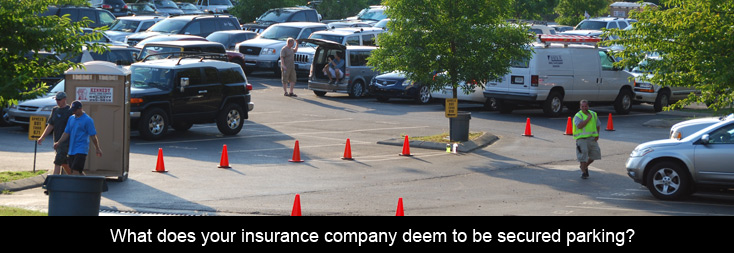
What does your insurance company deem to be secured parking?

One of the aspects considered by insurance companies when calculating car insurance premiums is where you park your car. This is an important component in calculating the risk of both loss and damage. Not only loss and damage from criminal activity may be affected, but also the damage from environmental disasters such as hail, falling debris etc.

It is also important to keep in mind that there are many different structures used for protection and not all parking spaces are the same. They differ with regards to materials used, methods to secure and “lock-in” the vehicle as well as with reference to access to the vehicle!

When an insurance company provides a quote on car insurance, the insurer asks for specific information from the vehicle owner/potential client. The client discloses these facts which the insurance company will not be aware of and might not even verify. The onus is on the client to make a full disclosure of all the material facts and failure to do so will amount to breach of contract and could nullify the insurance policy!

But is secure parking the same as parking in a locked garage?

We would like to illustrate this by using an example:

Example:

I have received a request from a work colleague and decided to share this with a few insurers:

-              What is regarded by Insurers with reference to secure parking as a locked garage?

-              Are there specific requirements as to dimensions and materials?

Example of Secure Parking

In the photos you will find a typical parking area at a townhouse complex in Bloemfontein.

The Garage area is closed with a lock – with an aluminium /steel roller door.

The gate is also secured with a lock.

There is a wall to the front and the one side – but not all around!

On the question – is your car parked in a locked garage - would Yes be the correct response?

Would the insured be under an obligation to provide additional details?

What would your advice be to ensure full compliance and the correct insurance?

Side view of parking space

We would like to share responses received from some of the Insurance companies:

MiWay:

  1. What is regarded by Insurers with reference to secure parking as a locked garage?
  • Enclosed locked (locked enclosure) – the vehicle is parked in a locked carport where the vehicle is still visible through the palisade/other fencing.
  • Locked garage – the vehicle is parked in a locked garage and the vehicle is not visible from outside.

2. Are there specific requirements as to dimensions and materials?

-          There is currently no restriction on the dimensions of a garage.  But it should be your personal garage – 3rd parties should not be able to see or have access to your vehicle(s) locked inside it.

-          For the structure to qualify as a locked garage, the vehicle should not be visible – this will rule out some materials such as palisades (or the lack of a sidewall in the example.)

Discovery Insure

-          What is regarded by Insurers with reference to secure parking as a locked garage?

A locked garage is regarded as an enclosed outbuilding with four walls and a garage door which could be a roller door, wooden door etc. that can be locked either by an electronic remote control or a key mechanism.

-          Are there specific requirements as to dimensions and materials?

There are various requirements and therefore the best is to consult a registered building contractor for assistance – but the DI wording states that all buildings on the premises must be constructed of brick, stone or concrete and covered with a roof made of slate, tile, concrete, fibrous cement, metal or thatch

-          On the question – is your car parked in a locked garage  - would Yes be the correct response

No, as the item in question would be regarded as a carport and not a garage as access can be gained by climbing over the wall next to the carport or breaking open the lock on the side gate to gain entry

-          Would the insured be under an obligation to provide additional details?

No as he already disclosed all

-          What would your advice be to ensure full compliance and the correct insurance?

Client would need to disclose that the vehicle is parked in a carport with a locked garage door but that access can be gained as the carport is not enclosed.  Full cover will be in place for the vehicle for theft and accidental damage.

Conclusion and Advice:

Rather disclose more than less! Keep in mind that not all insurers might have the same requirements and criteria for what is regarded as secure parking!

A full disclosure of all the facts will avoid having to spend the time and effort in unnecessary fights later. Explain your specific parking area to your insurer and even send photos as an example to be kept on record!

Medical Tourism Association SA launches Web Portal

In a move designed to showcase South Africa's high quality facilities and services for health, wellness and medical care in foreign markets, the Medical Tourism Association of South Africa (MTASA), will be launching a web portal in collaboration with a number of stakeholders at the Mediclinic Morningside on 23 February 2012.

“As a collective, we are here to ensure that medical tourists experience excellent service and high quality care throughout their stay in South Africa,” explains MTASA member Lorraine Melvill, of Joburg-based Surgeon & Safari, one of the country’s pioneering medical concierge consultancies, established in 1999. “The value chain includes numerous steps and players, products and services and the website www.medicaltourismassociation.org.za gives potential visitors a convenient information portal of services and facilities to get them started.”

Over the past 10 years Johannesburg has played host to thousands of visitors seeking health, wellness and medical services – often combined with short holidays either prior to or post their treatments and procedures. One company in particular, who has played a significant role is medical evacuation specialists ER 24, "We are excited about our membership with the medical tourism association and offer our expertise in medical evaluation, foreign patient facilitation and aero-medical evacuation to assist patients across Africa that have little or no access to quality healthcare," says Marc Fourie, Marketing Manager of ER24.

Such is the demand for these services that South Africa has emerged as a medical tourism destination of choice amongst African travellers more especially and the medical tourism sector, as a niche market with significant growth potential for the country, has been earmarked for development by national government. The intention of launching the portal is to bring about initiatives that advocate and showcase South Africa's world class medical facilities, services and personnel and thus position the country as a premier destination of choice for health / wellness and medical care, enabling its members to excel in this regional and globally competitive market, with a clear code of conduct in place.

"As a vital travel and medical services hub on the African continent, Johannesburg hosts a large proportion of medical tourists in South Africa," says Phelisa Mangcu, Acting CEO of Joburg Tourism Company (JTC). "In our role as the City of Johannesburg's destination marketing arm, we are supporting and amplifying MTASA's efforts by also unveiling our own medical tourism portal on the JTC website: www.joburgtourism.com to coincide with their national launch today".

The Medical Tourism Association of South Africa (MTASA) is a Section 21 non-profit trade association, which provides a common platform for diverse industry players with a collective interest in the medical tourism value chain. The launching of the MTASA web portal offers the industry an opportunity to commit to common values - integrity, transparency, accountability, direct communication, sound fiscal management and good corporate governance - that are conducive to the benefits of industry and consumers.

Also view:

Road Safety Advice for Foreigners travelling in South Africa

What is the best insurance for the mobile businessman and woman?

I am one of these newer generation workforce employees or bosses! With the enhanced internet connectivity we find many more entrepreneurs doing their own thing and working from behind their laptops, tablets and smartphones!

This is found especially amongst the somewhat younger generation and those who have carved a business career doing consulting services!

What are some of the main characteristics of the mobile worker?

-          Overheads are lowered by not buying a business property and having tens of people working for you.

-          You rent a working space and often share working space with other businesses.

-          You meet in coffee shops or travel to the business premises of your clients.

-          You are more focused on technology and rather pay a bit extra to ensure internet connectivity!

What are the major business risks?

This is no environment for the worker who needs an 8am -5pm job with all the extra employee benefits. It is true as some have said you leave your 8hour job to become your own boss so you can work 12 hours a day!

It is most important for the business owner or mobile employee to ensure the safety of business assets and intellectual capital that remains on the move all the time! As the mobile worker might not have the security net of group life and disability cover he should be more focused on ensuring that loved ones are cared for when he is there no more. His vehicle becomes one of his primary assets to ensure and he needs to know everything about car insurance and contents cover.

As the mobile worker is on the internet much of the time, he will use this medium to do research on the best insurance products available and is also more likely to make a purchasing decision on the internet.

Example:

Last week I travelled to Johannesburg for meetings from Wednesday to Friday. For most of the meetings all I needed was to take the iPad along to the boardroom. On Friday morning however I took my laptop into the boardroom at Imperial in Bedfordview and for some unexplainable reason left without the laptop. [yes – there are no pills for stupidity!]

The afternoon, returning to Bloemfontein, the receptionist at Imperial gave me a call and alerted me to having left behind my laptop. I am fortunate that it was well cared for and that it could be returned safely wrapped in bubble wrap etc via courier on Monday!

This however was a very clear warning - and I asked myself the following questions:

-          What if my laptop got stolen or smashed in a car crash?

-          What would I be losing and how long would it take to replace not only the movable asset /laptop, but also to return to full capacity with my work?

-          When last have I made back-up of data and emails on the computer?

-          How can I better protect and insure from potential losses if there is a business interruption?

Insurance Options:

I have browsed through the websites of some of the direct insurers and found insurance cover that could go a long way to ensuring that my business does not suffer all the devastating consequences from mishaps:

Car Insurance Cover: You simply cannot go without having comprehensive insurance if you are a mobile worker! Emergency roadside assistance would be another nice add-on!

Death and Disability Cover: If you have loved ones depending on you it is irresponsible to go without death and disability cover. You might also have colleagues and workers and will need to ensure that the necessary key person insurance is in place. Also talk to an expert on buy-sell agreements etc.

Personal Accident Insurance: If you are on the road often it might be important to consider insurance aimed at covering this specific hazard. Personal Accident Insurance allows you to cover your business partners or employees in case of accidental death or disability, directly caused by an accident. [The death or disability has to occur within 12 months of this injury.]

Remember to also mention items that are normally taken with you (e.g. laptops), etc that will fall under the OUT-of-the-Office section. What about business interruption cover (financial losses that you suffer because you’re unable to do business as usual) and maybe also money cover or stock-in-transit cover?

Business Contents Insurance: It is important to insure not only those items that may remain at a shared office space, but also those items that are normally taken with you (e.g. laptops). At OUTsurance this will fall under the OUT-of-the-Office section. You could also apply for stand-alone cover for your electronic equipment (i.e. licensed software, scanners, printers, audio or visual equipment, or electronic industrial equipment) - you don't need to take out contents insurance first.

Business Interruption Cover: This is described as follows by OUTsurance: “We'll cover financial losses you suffer due to the interruption of your business. The business interruption must be as a result of a loss following a valid claim on your building, contents, electronic equipment or stock.

You can cover financial loss relating to monthly fixed expenses payable; monthly operating profit because of a reduction in turnover; or any additional working expenses incurred.

You can apply for optional comprehensive subsidence cover where you'll receive cover in case of any downward movement of land caused by natural shifts, human activity, volume changes in clay-based soil caused by changes in moisture levels, as well as normal settlement, shrinkage or expansion of soil supporting the structure.

At OUTsurance, you can add optional theft cover to your existing business interruption cover. This means that if you submit a valid theft claim on your existing buildings, contents, stock or electronic equipment cover, you will also be able to claim for additional financial losses caused by the interruption of your business.”

Conclusion:

There are many things we cannot prevent. As we go through challenging financial times there are business risks out of our control. We can however protect ourselves from many other risks and loss threatening our business by considering a variety of insurance products available! Take the time and avoid emergency measures when it is too late!

Also view:

What is this Mobile Workforce and how will it impact on my Insurance Profile?

What are my career opportunities in Trauma Counselling?

Question:

I found your info on the internet and I was wondering of you could assist me with some information.

I just completed my BA in psychology but I am working in an unrelated field. I am contemplating doing my honors in trauma counseling but I am not sure of the career possibilities. Could you give me some type of indication? I am looking for a career change and this is something I am drawn to.

Thank you, I really appreciate your assistance.

Answer:

I trust this mail finds you well.

If you decide to do Honours in trauma counselling then once completed you can do a practical internship in trauma counselling through UNISA and can write a board exam for the Health Professions Council of SA to become a registered counsellor. Once you are a registered trauma counsellor then you can practice as a trauma counsellor on an independent basis or you can work with a company doing trauma counselling.

If you just decide to do your Honours in trauma counselling then you will still be able to be a trauma counsellor but may not necessarily practice independently, but can work or volunteer as a trauma counsellor at an organisation. It is better to become a registered trauma counsellor because you can charge medical aid rates which is easier for clients. Or you can work in a company that offers face-to-face or telephonic trauma counselling.

Your main career path would thus be to practice as a trauma counsellor. There are also many places you can volunteer as a counsellor whilst you do your Honours, such as the Police station or Victim support centre near you.

I hope this answers your question and if you have any questions about doing a trauma counselling internship through UNISA you can call them or email them for more info; it is called the BPSYCH Equivalence programme. HospiVision is also an organisation based in Pretoria which helps with UNISA trauma counselling internships, training and volunteering. You can also look them up on the internet.

Have a great day!

Kind Regards,

Kerry Wheater
Trauma Support Coordinator

ER24


Manor 2, Cambridge Manor, Cnr Witkoppen & Stonehaven, Paulshof
P.O. Box 242 Paulshof 2056
Tel:  011 319 6500

Emergency: 084-124

Website: www.er24.co.za

GPS: S -26 02.142 / E 28 03.162

Also view:

Trauma Counselling and Road Safety

From July all drivers in France must carry a breathalyser says IAM


The IAM is warning that from 1 July this year all drivers visiting France will need to carry a breathalyser kit in their cars, as French drivers will have to. From November there will be an €11 fine for not complying with this.

With a start date for the new measure of 1 July 2012, the rules will apply for anyone traveling to or through France by car in the summer holiday season, even just for a day trip.
Single-use breathalyser kits will satisfy the requirement. The legal limit in France is 50 mg per 100 ml of blood, lower than in the UK (the UK limit is 80mg). They cost between £1 and £2 and they will be available at ferry and tunnel terminals for crossings to France. It is intended that people will be able to test themselves to check whether or not they are over the French limit.

The IAM is advising motorists in France to have at least two breathalysers at all times, so that if one is used you still have one to produce for the police if you are stopped.
Anyone driving in France is already required to carry a warning triangle and a fluorescent safety vest to use in an emergency. Additionally UK motorists must display a GB plate and have their headlights adjusted to the right.

IAM director of policy and research Neil Greig said: “The new French rule is a genuine attempt to reduce the number of alcohol related-accidents. France’s lower limit means it’s very easy to be over the limit the morning after as well. As always, the best advice for motorists is not to drink and drive at all.”

Additional Info

1. IAM Motoring Facts 2011 shows that in 2009:
More than twice as many UK residents travel overseas than people from abroad visit the UK

❚ Three times as many UK residents take a car abroad than visitors from overseas bring a car to the UK
❚ 80 per cent of UK residents’ trips abroad were by air, 13 per cent by sea and seven per cent by the Channel Tunnel
❚ Of the almost six million trips by private vehicles from the UK to other EU countries, two thirds did not go beyond France, nine per cent went to Ireland, seven per cent to Belgium, six per cent to Netherlands, 4½ per cent to Germany, three per cent to Poland and two per cent to Spain.
Source: http://www.iam.org.uk/images/stories/downloads/Policy_and_Research/JourneysWeMakev2011.pdf.
2 The IAM is the UK’s largest independent road safety charity, dedicated to improving standards and safety in driving, motorcycling and cycling. The commercial division of the IAM operates through its occupational driver training company IAM Drive & Survive. The IAM has more than 200 local volunteer groups and over 100,000 members in the UK and Ireland. It is best known for the advanced driving test and the advanced driving, motorcycling and cycling courses. Its policy and research division offers advice and expertise on road safety.

[Source: PRWeb UK]

For Information about Drunk driving and Car Insurance, view:

Also view:

Survey reveals South Africans favours Karoo gas exploration BUT want more info on job creation, environment and electricity supply.

Although most adult South Africans were unaware of the possible exploration for natural gas in the Karoo, when introduced to the concept, the majority said that they are in favour of determining the presence of natural gas in the Karoo. Respondents wanted the pressing issues of job creation, economic development and environmental concerns to be addressed in the process. The prospect of natural gas development creating a reliable domestic energy source that would give more South Africans access to electricity was also of paramount importance.

These were the main findings of an opinion poll conducted by Ipsos for Shell during August and September 2011. Ipsos polled more than 2,000 South Africans on exploration for natural gas in the Karoo Basin. Face-to-face interviews allowed the interviewers to describe, inform and question respondents on shale gas, the process of hydraulic fracturing, their views on Shell and their hopes for South Africa.

Mari Harris, Director of Public Affairs at Ipsos, said, “Respondents clearly desire more information; they want to know if there is gas, how it will benefit them and what the impact will be.”

Awareness

The vast majority of South Africans (86%) were unaware of the possible exploration for natural gas in the Karoo and only 12% indicated that they had heard the term “hydraulic fracturing” before. As would be expected, awareness by word of mouth is higher among Karoo residents than among those living in other parts of the country, an indication of the greater relevance of shale gas exploration and hydraulic fracturing for people living in this area.

South Africans do want to know if there is gas in the Karoo

However, in spite of the very low awareness, when asked, more than seven in every ten adult South Africans (73%) were in favour of determining the presence of natural gas in the Karoo. If natural gas was proven to be present in the Karoo the same proportion (73%) would be in favour of gas extraction. However the proportion of those who are strongly in favour increases (from 39% to 45%), while the proportion of those in opposition decreases to 21%, with a larger group now uncertain as to how they feel about the issue (6%).

After the ideas of supporters of hydraulic fracturing were presented, about seven in every ten (69%) adult South Africans indicated that they were still in favour of gas exploration. After hearing views expressed by critics of the hydraulic fracturing process, the support for gas exploration reduced marginally to about two-thirds (66%).

South Africans care most about job creation

The study highlighted that job security and job creation remain very important issues in South Africa and more than half (54%) indicated that they would like more information on how gas exploration will benefit economic development and create jobs. Regarding infrastructure development, four out of every ten (39%) want information about how it will benefit the supply of and access to electricity. More information about the environmental impact of hydraulic fracturing was important to 41% and a third (35%) would like to know how clean burning natural gas will be.

Research Design and Technical Detail

This research project had been commissioned by Shell in order to measure the South Africans’ awareness of potential gas exploration in the Karoo and to gauge the opinion of the South African public regarding this issue.

2 006 face-to-face interviews were conducted in the homes of a representative sample of adult South Africans (18+ years old) using CAPI (Computer-Assisted Personal Interviewing) methodology.
The fieldwork period was from 4 August to 2 September 2011.

To promote ease of understanding and to ensure the best possible quality of results, interviews were conducted in the respondents’ language of choice.

The sample included respondents from all population groups, provinces and types of settlements, in the whole spectrum from metropolitan areas to rural areas.

A disproportionately high number of interviews were conducted in the Karoo areas to ensure that the opinions of those members of the public who would be most impacted by any further development in the Karoo were adequately represented.

At the analysis stage all findings were weighted to represent the total adult population of South Africa in its correct proportions.
The sample error is 2, 2%.

About Ipsos: The Home of Researchers

Ipsos is an innovative, entrepreneurial, client-focused organisation, providing research services to clients on a global basis. We set ourselves high standards and aim to work collaboratively in partnership with our teams in order to service our clients most effectively.

Ipsos recently acquired Synovate globally.

Ipsos is proud to be the only global market research company that is still controlled and operated by market researchers. We aim to remain the natural home for intellectually curious and passionate researchers.

Our goal is simple: to be our clients' preferred research partners in our areas of specialisation, based on BQC (Better, Quicker, Cheaper) methodologies and processes. We want our clients to be proud and pleased to work with us - and we want each one of us to be proud and pleased to offer our clients high quality standards, efficiency and intelligence.